
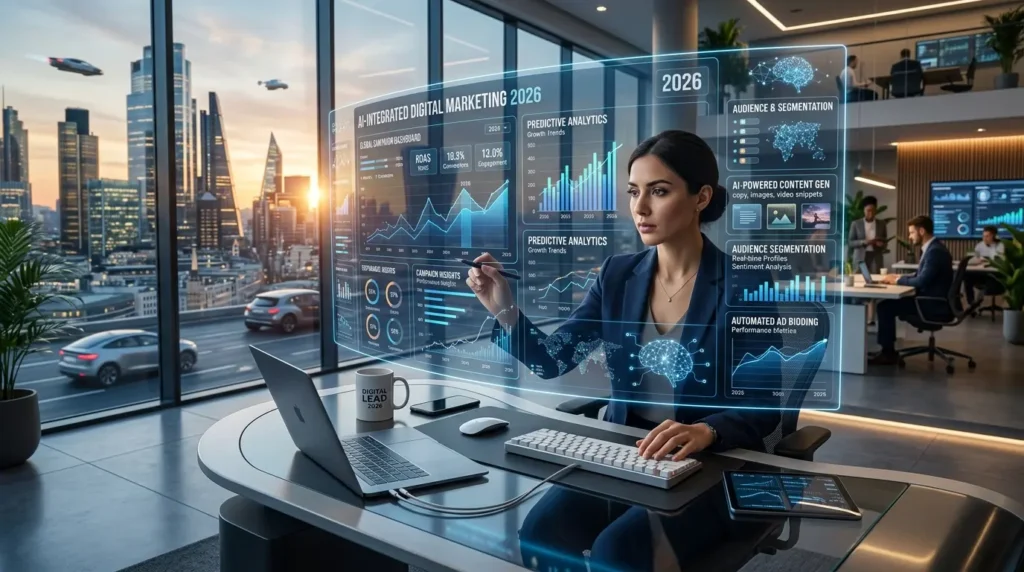
AI-Integrated Digital Marketing in 2026
Introduction: Marketing Has Been Rewired
Digital marketing in 2026 is not the same discipline it was three years ago. Artificial intelligence has not simply added a layer of automation to existing workflows. It has fundamentally restructured how brands find audiences, how audiences discover brands, and how decisions get made in between.
The marketers who are winning right now are not the ones who know the most tools. They are the ones who understand how to think alongside AI, using it as a strategic partner rather than a shortcut.
This guide breaks down exactly what AI-integrated digital marketing looks like in 2026, which skills matter, which tools are essential, and how you can position yourself, whether you are a business owner, a marketing professional, or someone building a career from scratch.
What Is AI-Integrated Digital Marketing?
AI-integrated digital marketing refers to the practice of embedding artificial intelligence across every stage of the marketing funnel, from audience research and content creation to campaign optimization and customer retention.
It goes beyond using ChatGPT to write captions. True AI integration means:
-
- Using predictive models to identify high-intent audiences before they search
-
- Automating personalization at scale across email, ads, and web experiences
-
- Optimizing campaigns in real time using machine learning signals
-
- Creating content strategies informed by AI-driven keyword clustering and intent mapping
-
- Leveraging Generative Engine Optimization (GEO) to appear in AI-powered search overviews
In short, AI-integrated marketing is the difference between reacting to data and predicting what the data will say next.
Why 2026 Is the Most Critical Year in Digital Marketing History
Several converging forces have made 2026 a pivotal moment:
1. The Death of Third-Party Cookies: Tracking users across the web through third-party cookies is now effectively over. Marketers must now rely on zero-party data (information customers voluntarily share) and first-party data (data collected directly from owned channels). AI tools are the only scalable way to make sense of this fragmented data landscape.
2. The Rise of Answer Engines: Google, Bing, and emerging AI platforms no longer just return blue links. They return answers! Synthesized, AI-generated responses that pull from authoritative sources. If your content is not optimized for these generative overviews, your organic visibility is quietly shrinking.
3. Hyper-Personalization Is Now the Baseline: Consumers in 2026 expect personalized experiences as standard. AI makes it possible to deliver dynamic content, personalized email flows, and custom ad creatives at a scale that would have required an entire department just five years ago.
4. AI is Closing the Execution Gap: Small businesses and solo marketers can now compete with large agencies because AI tools have dramatically lowered the cost and time of execution. This levels the playing field, but only for those who know how to use it.
The Core Pillars of AI-Integrated Digital Marketing in 2026
1. Generative Engine Optimization (GEO)
Traditional SEO focused on ranking in the top ten blue links. GEO focuses on being the source that AI cites in its generated answers.
To win at GEO in 2026, your content must:
-
- Demonstrate genuine expertise, authority, and trustworthiness (Google’s E-E-A-T framework)
-
- Answer questions directly and completely, not just include keywords.
-
- Be structured, so AI models can extract and cite it with confidence.
-
- Be supported by strong brand signals across multiple platforms, backlinks, mentions, social proof, and consistent publishing.
GEO is not a replacement for SEO. It is an evolution. The fundamentals of creating genuinely useful, well-structured content still apply, but the optimization layer has grown significantly more sophisticated.
2. AI-Powered Paid Advertising
Platforms like Google Ads and Meta Ads have shifted from manual campaign management to AI-first campaign structures. Performance Max on Google and Advantage+ on Meta now handle much of the bidding, audience targeting, and creative testing automatically.
This does not mean the human marketer is obsolete. It means the human marketer’s role has shifted toward:
-
- Feeding the AI system with high-quality creative assets and clear conversion signals.
-
- Structuring campaigns in a way that gives the algorithm clean, usable data.
-
- Interpreting performance signals and making strategic adjustments.
-
- Understanding attribution models and how to measure true ROAS in a privacy-first environment.
The marketers who treat AI ad tools as a black box will lose. Those who understand how to guide the machine will consistently outperform.
3. AI-Driven Content Marketing
Content marketing in 2026 is not about publishing more. It is about publishing smarter.
AI tools can now assist with:
-
- Topic research and content gap analysis.
-
- Keyword clustering and semantic SEO.
-
- First-draft generation and outline building.
-
- Content repurposing across formats and platforms.
-
- Personalized content recommendations for different audience segments.
However, the content that ranks and converts in 2026 still requires a human layer, original insights, real experience, genuine voice, and strategic intent. AI handles the scaffolding. Humans build what matters inside it.
4. Predictive Analytics and Customer Intelligence
The shift from descriptive analytics (what happened) to predictive analytics (what will happen) is one of the most significant changes in marketing practice over the past two years.
Marketers who can work with tools that model customer lifetime value (CLV), predict churn, score leads by conversion probability, and build attribution models across a complex buyer journey are now among the most valuable professionals in the industry.
You do not need to be a data scientist. But you do need to be comfortable moving beyond vanity metrics in Google Analytics 4 and building reports that connect marketing activity to business outcomes.
5. Conversational AI and Customer Experience
AI chatbots, voice assistants, and conversational interfaces have matured significantly. In 2026, brands that deploy AI effectively at touchpoints across the customer journey — from first website visit to post-purchase support are seeing measurable improvements in conversion rates and customer satisfaction scores.
The key is designing these experiences with intention. AI conversations that feel mechanical or scripted undermine trust. Those who feel helpful, contextual, and fast build it.
Essential AI Tools Every Digital Marketer Needs in 2026
Here is a practical stack for an AI-integrated marketing professional:
Content and Copy
SEO and GEO
-
- Surfer SEO or Clearscope for on-page optimization and content scoring.
-
- Search listening tools for intent-based topic discovery.
Paid Advertising
-
- Google Performance Max with a strong creative asset library.
-
- Meta Advantage+ with structured audience signals.
-
- Madgicx or Revealbot for AI-powered ad optimization and automation.
Analytics and Attribution
-
- Google Analytics 4 with custom event tracking.
-
- Triple Whale or Northbeam for multi-touch attribution (especially for e-commerce).
-
- Looker Studio for building executive-ready reporting dashboards.
Automation and CRM
-
- HubSpot or ActiveCampaign for AI-assisted email flows and lead scoring.
Career Opportunities in AI-Integrated Digital Marketing
The demand for AI-literate marketers is significantly outpacing supply. Here is what the landscape looks like in 2026:
AI Marketing Strategist Responsible for designing the overall AI integration roadmap for a brand’s marketing function. Requires deep knowledge of both marketing principles and AI capabilities.
Performance Marketing Specialist Manages paid media campaigns across Google, Meta, and programmatic channels. In 2026, this role requires fluency in AI-first campaign structures and privacy-compliant tracking setups.
Content and GEO Specialist Creates content strategies optimized for both traditional search and AI-generated answer engines. A fast-growing niche with limited competition among truly qualified practitioners.
Marketing Data Analyst Translates campaign and customer data into strategic recommendations. The addition of predictive modeling and AI-assisted analysis has made this role significantly more impactful.
Growth Marketer Sits at the intersection of product, data, and marketing. Uses AI tools to identify and exploit growth loops across acquisition, activation, retention, and referral.
How to Build Your AI Marketing Skills in 2026
Certifications still have value for credibility, but practical skills built through real work are what employers and clients actually pay for. Here is a realistic path:
Step 1: Build your foundation. Understand the core principles of marketing psychology, consumer behavior, and business strategy. AI amplifies your thinking, it does not replace the need for good thinking.
Step 2: Get hands-on with tools. Do not just read about AI marketing tools. Run campaigns. Test prompts. Build dashboards. Make mistakes on small budgets before you make them on large ones.
Step 3: Develop a documented portfolio. Case studies that show a real problem, your approach, and measurable results will open doors that certifications alone will not.
Step 4: Specialize deliberately. Pick one or two areas – GEO, performance marketing, analytics, automation, and go deep. The T-shaped marketer with genuine depth in a high-demand area commands a premium.
Step 5: Stay in continuous learning mode. AI is evolving faster than any marketing discipline in history. Build the habit of regular learning into your schedule, not as a one-time sprint.
Local Businesses and AI Marketing: A Significant Opportunity
For locally-focused businesses, especially in rapidly growing markets like South India, the UAE, and Southeast Asia, AI-integrated marketing represents an enormous opportunity that most competitors are not yet taking advantage of.
AI tools now make it possible for a local business to:
-
- Run hyper-targeted ad campaigns that would previously have required an agency.
-
- Optimize their Google Business Profile with data-driven insights.
-
- Create localized content at scale in multiple languages.
-
- Respond to customer inquiries instantly through conversational AI.
-
- Understand which marketing activities are actually driving foot traffic and leads.
The barrier to entry has never been lower. The window of competitive advantage for early adopters has never been more open.
Start Your AI Marketing Journey With Expert Guidance
Understanding AI-integrated marketing is one thing. Building the hands-on skills that employers and clients actually pay for is another.
At Edustack Academy, our Digital Marketing program is built around exactly what the industry demands in 2026. Practical, portfolio-driven training that takes you from foundational concepts to job-ready execution. Whether you are starting from scratch or looking to upgrade your existing skills, our curriculum is designed to keep you ahead of the curve.
Explore Our Digital Marketing Course →
Conclusion: Intelligence Is the New Execution
For the past decade, digital marketing rewarded those who could execute faster and at greater scale. In 2026, the edge belongs to those who can think more clearly about audiences, data, what AI can and cannot do, and about how to combine human creativity with machine intelligence.
The professionals and businesses who will define the next era of marketing are not waiting for AI to become more mature. They are building their skills and strategies around it right now.
The roadmap is clear. The tools are available. What remains is the decision to commit to learning and applying them with genuine seriousness.
What is AI-integrated digital marketing?
It is the practice of embedding artificial intelligence across every stage of the marketing process. From audience research and content creation to paid advertising, analytics, and customer experience. It is not just about using AI tools; it is about building a smarter, faster, and more data-driven marketing strategy.Is AI replacing digital marketers in 2026?
No. AI is automating repetitive tasks, but the strategic thinking, creativity, and human judgment behind great marketing still require people. The marketers thriving right now are those who use AI to do more, not those waiting to be replaced by it.What is Generative Engine Optimization (GEO) and why does it matter?
GEO is the practice of optimizing your content so that AI-powered answer engines, such as Google’s AI Overviews, cite your brand as a trusted source. As search behavior shifts from clicking links to reading AI-generated answers, GEO is becoming as essential as traditional SEO.Which AI tools should a digital marketer learn first?
Start with a large language model like Claude or ChatGPT for content and ideation, Google Analytics 4 for data, and whichever ad platform is most relevant to your niche, Google or Meta. Build depth in one area before spreading across too many tools.How long does it take to build job-ready AI marketing skills?
Most learners get there within six to twelve months with consistent, practical effort. At Edustack Academy, our program is structured to accelerate that timeline through real campaign work, live projects, and portfolio building. So, you are not just certified, you are capable.Do I need a technical background to learn AI-integrated digital marketing?
Not at all. While comfort with data and tools certainly helps, the most important skills are strategic thinking, curiosity, and a willingness to learn by doing. Edustack Academy‘s curriculum is designed for learners from all backgrounds, including those with zero prior marketing or tech experience.Is local SEO still relevant when AI is changing how people search?
Yes, and arguably more so. Local intent remains one of the strongest signals in search, and AI has made it possible to optimize local presence more precisely than ever. For businesses targeting specific cities or regions, local SEO combined with AI tools is one of the highest-return strategies available right now.What is the difference between traditional digital marketing and AI-integrated digital marketing?
Traditional digital marketing relies heavily on manual execution, writing content, setting bids, and building audiences by hand. AI-integrated marketing uses intelligent systems to automate, personalize, and optimize those same activities at a scale and speed that was previously impossible. The strategy still requires humans. The execution is increasingly AI-assisted.