
Table of Contents
ToggleWhy Project-Based Learning in Digital Marketing is the Ultimate Gold Standard for 2026
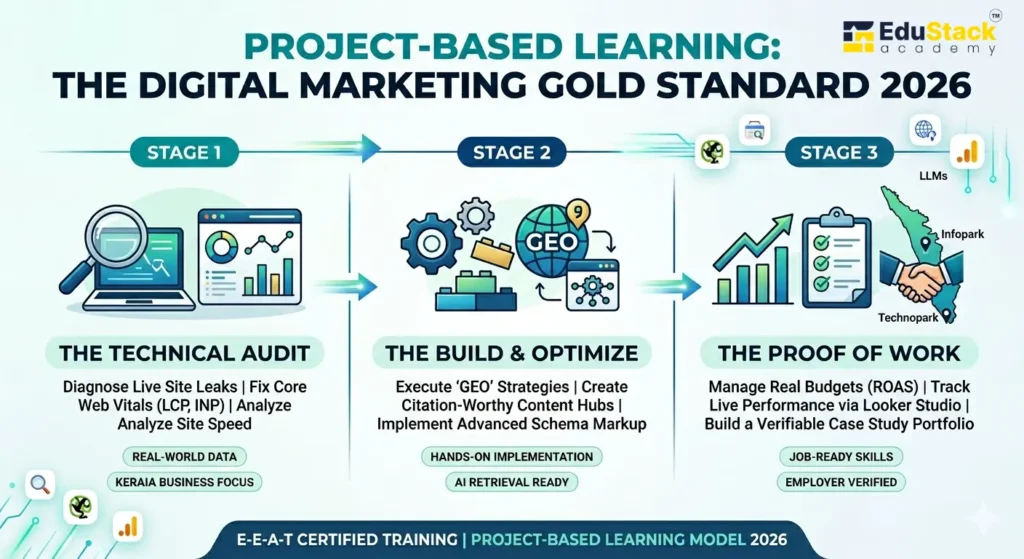
The reality check for the Kerala digital workforce in April 2026 is that a certificate just shows you have seen a video, while Project-Based Learning in Digital Marketing proves you have solved an actual problem. Since AI-powered tools can now easily crack the usual certification test, the recruitment teams from the best companies of Kochi and Trivandrum will not even look at your resume without Proof of Work. To land roles in Technopark or Kochi, you must demonstrate project-based learning in digital marketing through a verified portfolio. Refer to our Digital Marketing Career Guide for Kerala 2026 for the full breakdown of in-demand skills.
The Hands-On Gap: Why Theory Fails in 2026
Traditional rote learning cannot keep up with the technical demands of 2026. As discussed in our guide to the essential skill stack for 2026, factors like Interaction to Next Paint (INP) and Generative Engine Optimization (GEO) require more than just textbook knowledge.
The Complexity of Real Data: A mock SEO campaign doesn’t prepare you for a sudden Google Core Update or a server-side database lock on a WordPress site.
The Multi-Tool Workflow: In a project environment, you aren’t just doing SEO. You are using Search Console to identify leaks, Screaming Frog for technical crawls, and LLMs to map out semantic clusters simultaneously.
The Anatomy of an EduStack Live Project Module
At EduStack Academy, we have moved beyond simulations. Our Project-Based Learning Modules are built around three specific High-Intent pillars:
The Technical Audit (Local Business focus): Students take a live Kerala-based business website and perform a full technical overhaul—optimizing Core Web Vitals and fixing render-blocking resources. Students access our proprietary Sandbox Server, which mirrors the database architecture of a live e-commerce site, ensuring you face real-world rendering issues rather than a sanitized simulation.
The GEO Content Cluster: Instead of just writing a blog, students build a Citation-Worthy content hub designed to be referenced by AI search engines like Gemini.
The Performance Dashboard: Students manage real (or simulated high-stakes) budgets, tracking ROAS and CPL via Data Studio (Formerly known as Looker Studio), providing the exact reports a Technopark hiring manager expects to see.
How to Use Project-Based Learning in Digital Marketing for Portfolio Growth ?
By 2026, your portfolio will be your true resume. The following project-oriented approach would give you the opportunity to use the STAR approach:
Situation: The local e-commerce brand was facing an LCP lag of 3 seconds.
Task: Decrease load time to under 1.2s for better rankings on search engines.
Action: Optimization of the CSS delivery process and adaptive image loading.
Result: Organic traffic increased by 40% within 30 days
Building a portfolio is only half the battle—knowing how to present it to employers is the other. Check out our comprehensive guide to Kerala’s digital marketing career paths and salary benchmarks to learn how to position your projects as a solution to the specific challenges hiring managers are facing in 2026.
Conclusion
The transition from student to professional in Kerala’s 2026 digital economy is no longer about the number of hours spent in a classroom—it’s about the number of problems solved on a screen. By prioritizing Project-Based Learning Modules, you aren’t just learning digital marketing; you are practicing it.
Frequently Asked Questions
Is a digital marketing certificate enough to get a job in Technopark or Infopark in 2026?
No. In 2026, certifications only prove you have completed a course. Hiring managers in hubs like Technopark and Infopark now prioritize Proof of Work—a portfolio demonstrating that you have solved real-world technical problems like Core Web Vitals audits, GEO-content strategy, and performance campaign management.
How does project-based learning differ from a standard internship?
Standard internships often involve repetitive, low-impact tasks. Our project-based learning modules are designed specifically for skill-building; you work in a controlled, proprietary sandbox environment to diagnose and fix technical issues, manage simulated high-stakes budgets, and build a portfolio-ready case study before you ever enter a job interview.
I have no technical background. Can I still succeed in project-based modules?
Absolutely. Project-based learning is actually the most efficient way for beginners to learn because you aren’t just memorizing definitions; you are applying them. By working on live-data projects, you quickly understand how technical SEO and analytics tools (like GA4 and Search Console) function in a real-world business context.
Will project-based learning help me if I want to work remotely for international clients?
Yes. International clients and remote employers look for demonstrable results. When you can show an employer a case study—using the STAR method to explain the situation, task, action, and the 40%+ organic growth you achieved in a project—you prove that you can deliver value regardless of your physical location.